
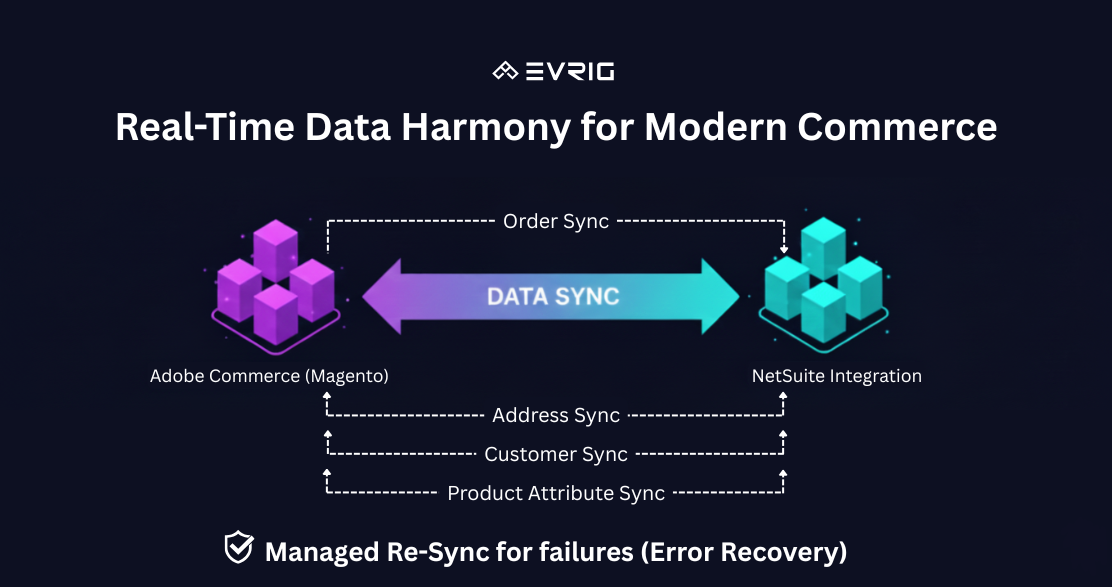
As businesses scale, synchronizing data across multiple systems becomes critical to maintain operational accuracy, customer satisfaction, and seamless fulfillment. One of the most powerful pairings in enterprise ecommerce is Adobe Commerce (Magento) and NetSuite ERP—but to unlock true efficiency, the integration needs real-time, automated, and dependable synchronization.
In this blog post, we walk through a typical high-performance sync architecture between Adobe Commerce and NetSuite, outlining key data touchpoints, frequency schedules, and direction of flow.
Product Attribute Sync
Managing product attributes across systems is essential for maintaining product integrity, improving search relevance, and enhancing merchandising. This integration setup ensures your catalog always stays consistent.
- Delta Product Attribute Sync — Every 15 Minutes
Only the modified product attributes are synced, ensuring fast updates with minimal system load. - Full Product Attribute Sync — Once Per Day
A complete catalog attribute refresh ensures long-term accuracy and resolves any missed deltas.
Inventory Sync
Inventory accuracy directly impacts customer trust and order experience—especially for high-margin or limited-stock products.
- Delta Inventory Sync — Every 1 Minute
Near real-time updates prevent overselling and keep stock levels constantly fresh. - Full Inventory Sync — Once Per Day
Daily reconciliation ensures both systems remain perfectly aligned.
Order Sync
Frequency: Every 15 minutes
Direction: Adobe Commerce → NetSuite (One-Way)
Order synchronization includes:
- Assigned Sales Representative
- Estimated Delivery Date
- Payment and fulfillment attributes
- Applied promotions and customer group metadata
This ensures NetSuite receives clean and complete ecommerce orders for fulfillment, invoicing, and accounting.
Customer Sync
Frequency: Every 1 Hour
Direction: Adobe Commerce ↔ NetSuite (Two-Way)
Customer profiles—including B2B accounts, segments, and tax exemptions—stay consistent across both platforms. Updates can originate from customer service teams, ecommerce users, or operational processes.
Customer Address Sync
Frequency: Every 1 Hour
Direction: Adobe Commerce ↔ NetSuite (Two-Way)
Shipping and billing addresses sync bi-directionally so that warehouse, account management, and shoppers always see the most up-to-date information.
Managed Re-Sync for Failures (Error Recovery Framework)
Even with automation, network interruptions, unexpected data mismatches, or validation exceptions can cause sync failures. To maintain reliability, a Managed Re-Sync Framework is configured for:
Failed Order Resync
Automatically detects orders that could not sync—due to missing fields, API downtime, format failures, or NetSuite validation errors—and retries them using:
- Smart retry queue with exponential retry logic
- Error tagging and logging for support visibility
- Admin panel override to trigger manual resync
This ensures no order is left behind and operational teams do not rely on manual exports.
Failed Inventory Update Resync
If any inventory update fails—whether during peak traffic or ERP latency—the system:
- Moves the record to a retry queue
- Attempts automatic recovery
- Sends alerts if manual intervention is required
This guarantees inventory accuracy even during high-volume operations, maintenance windows, or API throttling.
Why This Schedule Works
This integration cadence strikes the balance between:
- System performance
- Accuracy
- Real-time business requirements
- Operational safety (via daily full sync reconciliation)
With delta syncs running frequently and full syncs scheduled daily, the integration stays resilient, efficient, and scalable.
Final Thoughts
A well-structured Adobe Commerce ↔ NetSuite integration unlocks operational automation, reduces manual data entry, and creates a unified data ecosystem across ecommerce, ERP, warehouse, and CRM workflows.
Whether you're scaling B2B operations, managing complex inventory, or supporting multi-channel commerce, this setup ensures both platforms work together as one intelligent engine.
How Evrig Can Help
At Evrig, we specialize in Adobe Commerce and NetSuite integrations.
We’ve successfully implemented this architecture in multiple live projects, helping businesses seamlessly manage products, customers, orders, and inventory across both systems. Our proven integration solutions ensure stability, accuracy, and scalability—tailored to your business needs.
If you're looking to integrate Adobe Commerce with NetSuite or optimize your existing setup, we’re here to help.
Ready to streamline your ecommerce and ERP operations?
Get in touch with our team at Evrig to discuss your integration requirements and explore how we can support your growth.